
Commotio Cordis: When a Blow to the Chest Causes Cardiac Arrest in Sport
3rd November 2026
Brian Carlin | Immediate Care Training
Commotio Cordis: When a Blow to the Chest Causes Cardiac Arrest in Sport
SPoRTS Clinical Learning Point 001 | 3 November 2026
A Tragic Incident in Football
Reports concerning a Tenerife footballer who died following a collision with a goalkeeper highlight the importance of recognising life-threatening emergencies in sport. Accounts describe a blow involving the chest and subsequent cardiac arrest and neurological deterioration.
The exact cause of the cardiac arrest has not been publicly established. This case is an opportunity to explore commotio cordis as a possible mechanism after blunt chest impact, not to diagnose it in this individual.
Our thoughts are with the player's family, teammates and everyone affected.
What Is Commotio Cordis?
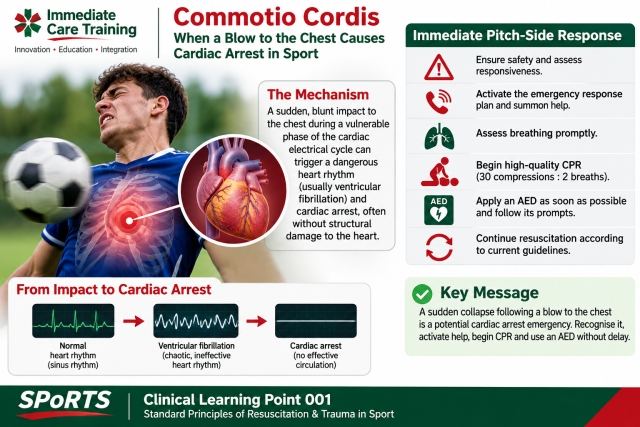
Commotio cordis is sudden cardiac arrest caused by a blunt, non-penetrating impact over the heart at a vulnerable moment in the cardiac electrical cycle. The impact may trigger ventricular fibrillation without structural damage to the heart.
Recognition and Immediate Management
Following a chest impact, sudden collapse, unresponsiveness and absent or abnormal breathing must prompt immediate assessment for cardiac arrest. Agonal gasps are not normal breathing.
- Ensure scene safety and check responsiveness.
- Activate the emergency response plan and summon emergency medical help.
- Assess breathing promptly; healthcare professionals should follow their current resuscitation training.
- Begin high-quality CPR if cardiac arrest is recognised.
- Apply an AED as soon as available and follow its prompts.
- Continue resuscitation according to current guidelines and address other serious traumatic causes where appropriate.
Clinical learning point: Do not delay CPR or AED application while trying to establish whether the cause is commotio cordis.
Commotio Cordis and Other Causes of Traumatic Cardiac Arrest
Not every cardiac arrest after a collision is commotio cordis. Significant trauma may also cause structural cardiac injury, severe haemorrhage, hypoxia, tension pneumothorax or other life-threatening complications. Assessment and management depend on the clinical presentation, mechanism and responder competence.
The Importance of Pitch-Side Preparedness
Every sporting organisation should have a rehearsed Emergency Action Plan covering responder roles, access to an AED, communication, emergency equipment, ambulance access and transfer arrangements.
SPoRTS: Translating Knowledge into Practice
Immediate Care Training's Standard Principles of Resuscitation & Trauma in Sport (SPoRTS) courses focus on structured assessment, resuscitation, trauma management, teamwork and realistic scenario-based learning.
Key message: Sudden collapse after a blow to the chest is a potential cardiac arrest emergency. Recognise it, call for help, begin CPR and use an AED without delay.
Further Reading
Clinical education note: Commotio cordis has not been confirmed as the cause of cardiac arrest in the reported football incident. This article does not imply a diagnosis or judgement about the medical care provided.
Immediate Care Training | SPoRTS Clinical Learning Point 001
Recent articles
